
Why Your Website Isn't Showing Up on Google and What to Do About It
THE SHORT ANSWER
Your Albuquerque website isn’t showing up on Google because Google needs three things to rank a site: relevant content using the words your customers actually search, a technically healthy site it can crawl, and enough credibility signals — links, reviews, activity — to trust that you’re a real, current business. Most small business sites are missing at least one of these, and the gaps are fixable.
Why Google Visibility Matters More Than You Think
When someone in Albuquerque searches for the service you provide, you want your business to appear — not on page four, not buried below directories and competitors who’ve been around half as long as you have, but near the top, where people actually click.
Most users don’t scroll past the first few results. If your site isn’t there, those potential customers don’t know you exist. Your website can be well-designed, clearly written, and genuinely helpful — and still be invisible if the underlying SEO foundation isn’t solid.
We work with small businesses across New Mexico who’ve had this exact experience. The website looks fine. It just doesn’t perform. And the reasons, once you know what to look for, usually come down to a handful of fixable issues.
The Most Common Reasons Your Site Isn’t Ranking
Your Site Is Too New
Google takes time to crawl and index new websites. If your site launched in the last few months, it may simply not have had enough time to build credibility in Google’s eyes. This is normal — but it’s also why consistent content and backlink building matter from day one, not just at launch.
You’re Targeting the Wrong Keywords
A lot of Albuquerque small business websites are written the way the owner thinks about their business — not the way customers search for it. If your homepage says “innovative solutions for modern enterprises” but your customers are searching “web designer Albuquerque” or “small business website Albuquerque NM,” there’s a disconnect. Google can’t read minds. It needs to see the words people are actually using.
Your Site Has Technical Problems
Slow load times, broken links, pages that aren’t indexed, missing meta descriptions, or a site structure that search engines can’t crawl efficiently — these issues quietly suppress your rankings without ever throwing an obvious error. Most business owners have no idea they exist until someone looks.
A website maintenance and management plan that includes regular technical checks is one of the most effective ways to catch these problems before they compound.
You Don’t Have Enough Quality Content
Google rewards websites that consistently demonstrate expertise on a topic. A five-page brochure site with no blog, no updated content, and no internal structure gives Google very little to work with. It doesn’t know what you’re an authority on, so it doesn’t rank you for much.
This is one reason content strategy and professional web design services need to be connected from the start — the structure of your site affects how well your content performs.
You Have No Backlinks
Backlinks are links from other websites pointing to yours. Google treats them like votes of confidence. A brand new site with no backlinks looks like a stranger no one can vouch for. Building backlinks takes time, but even a few quality ones — from a local business directory, a chamber of commerce listing, or a press mention — make a real difference early on.
Your Google Business Profile Is Incomplete or Unclaimed
For local searches (“web designer near me,” “Albuquerque small business web design”), your Google Business Profile often matters as much as your website. If it’s unclaimed, incomplete, or hasn’t been updated in years, you’re losing local visibility that has nothing to do with your actual site.
What “Showing Up on Google” Actually Means
It’s worth being specific here, because there are different ways to appear in search results — and they require different strategies.
Organic results are the standard blue links. Ranking here takes time and consistent SEO work.
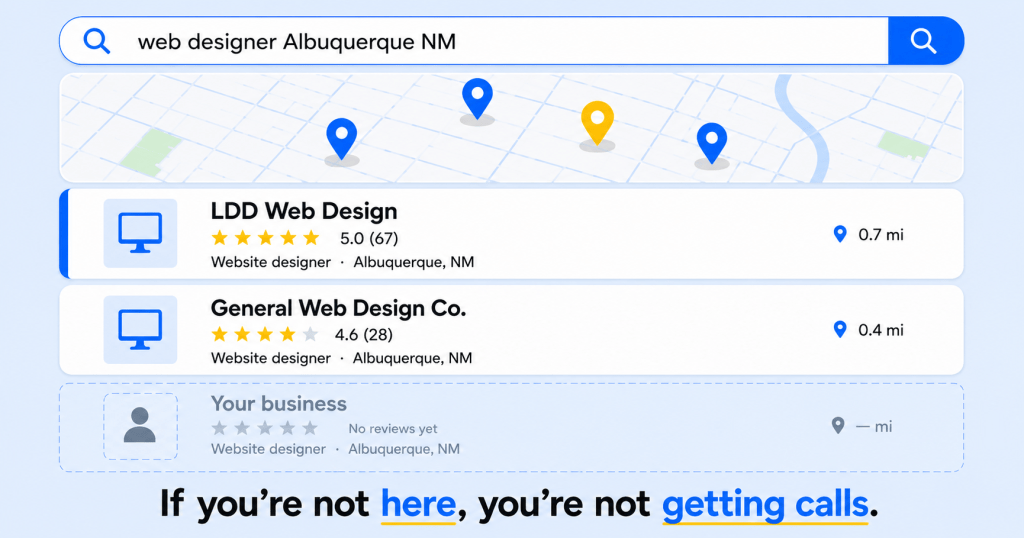
Local Pack results are the map listings that appear for location-based searches. These are driven by your Google Business Profile, your proximity to the searcher, and your review count and quality.
AI Overviews are Google’s newer AI-generated summaries at the top of results. These pull from well-structured, authoritative content — which is one reason the way your site is written and organized matters more now than it did a few years ago.
Most small businesses want all three. The foundation — good site structure, targeted content, a complete Google Business Profile — supports all of them.
Common Mistakes We See
Mistake 1 — Assuming the Website Launch Was the Finish Line
Getting a website live is a milestone. But it’s not the end of the work. We regularly hear from business owners who had a site built two or three years ago, haven’t touched it since, and can’t figure out why it doesn’t rank. Google favors active, maintained sites over static ones.
Pro tip: Even small updates — a new blog post, a refreshed service page, an updated photo — signal to Google that your site is current and worth indexing.
Mistake 2 — Optimizing for the Wrong Location
We’ve seen Albuquerque businesses whose websites never mention Albuquerque, New Mexico, or even the Southwest. If your content doesn’t include geographic signals, Google has no reason to surface your site for local searches. This one is almost always a quick fix.
Mistake 3 — Ignoring Mobile Performance
More than half of all searches now happen on phones. Google uses mobile performance as a primary ranking factor. A site that’s slow to load on mobile, hard to navigate, or visually broken on smaller screens is actively penalized in rankings — not just in user experience. If you haven’t checked how your site performs on a phone recently, it’s worth doing.
Mistake 4 — Treating SEO as a One-Time Task
SEO isn’t something you do once and forget. Algorithms change, competitors update their content, and new search behaviors emerge. Businesses that consistently invest in their website’s SEO — even modestly — outperform those who treat it as a checkbox.
Frequently Asked Questions
Why does my website show up when I search my exact business name but not for anything else?
Searching your business name is called a branded search — Google has indexed you, but hasn’t established enough topical or geographic authority to surface you for broader queries. This is a content and SEO strategy issue, not a technical one.
How long does SEO take to work?
For a new site or one starting from scratch, most businesses start seeing meaningful movement in three to six months with consistent effort. Competitive industries or highly saturated markets take longer. There are no reliable shortcuts.
Do I need to pay for Google Ads if organic SEO isn't working yet?
Google Ads can be a useful bridge while organic rankings build — but they don’t contribute to long-term SEO. If ads are running and you’re seeing results, that’s worth noting. It’s also worth addressing why organic isn’t performing, because ads stop the moment you stop paying.
Can I do SEO myself?
Some of it, yes. Updating your Google Business Profile, writing content that addresses real customer questions, and keeping your site technically healthy are all things a motivated business owner can manage. The more competitive your market, the more value there is in working with someone who does this full-time.
Does having a blog actually help SEO?
Yes — but only if the content is targeted and maintained. A blog that covers real questions your customers ask, written with specific keywords in mind, builds topical authority over time. A blog with five posts from 2021 and nothing since does very little.
I just had my site redesigned. Why isn't it ranking better?
A redesign improves structure, usability, and credibility — all of which support SEO. But a new site still needs time to build authority. If the redesign included keyword research and proper technical foundations, you’re set up to rank. Here’s what to expect from a website redesign timeline and how the SEO work fits in.
If your website isn’t performing the way you’d hoped, the first step is understanding why. The issues are usually specific — and more fixable than they feel from the outside.
We’re happy to take a look at what might be holding your site back. Reach out here.
Related Articles
Website Redesign vs. Website Refresh — How to Know Which You Need
The Hidden Costs of Ignoring Website Maintenance
Sources
Google — How Google Search Works
Moz — Beginner’s Guide to SEO
StatCounter — Mobile Search Engine Market Share Worldwide

David Luft
Founder, LDD Web DesignDavid launched LDD Web Design out of a natural extension of LDD Consulting — the Albuquerque IT company he founded in 2003. What started with intranet services for local businesses grew into a full web design division, and for more than 15 years he’s been building custom websites for small businesses, organizations, and educational institutions across New Mexico.
Linkedin | Learn More About David